This portfolio
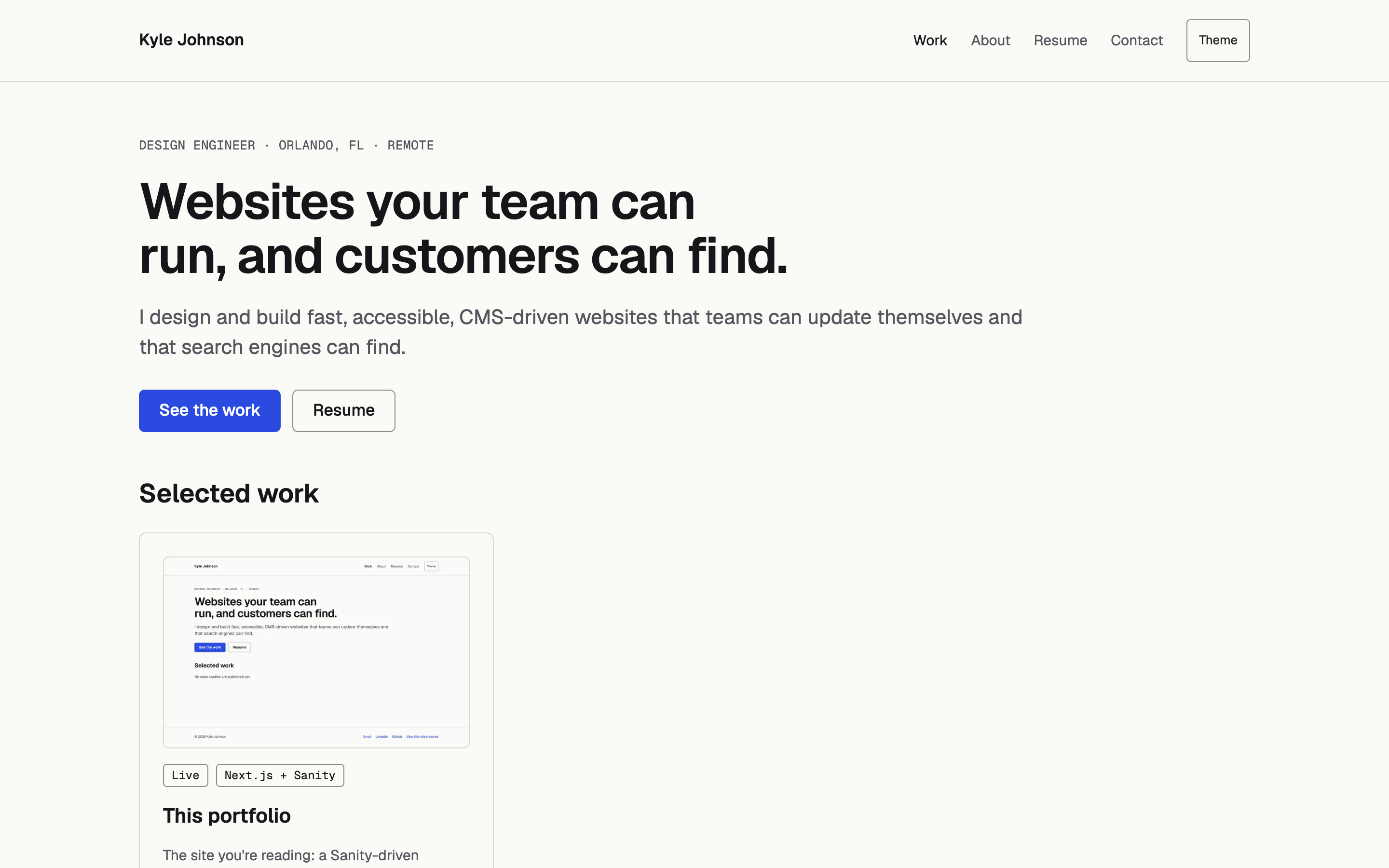
The site you're reading: a Sanity-driven portfolio that refuses to publish an unsourced number, tested for speed and accessibility on every push.
- Role
- Designer and developer
- Stack
- Next.js 16, TypeScript, Tailwind CSS v4, Sanity v6, Vercel, Playwright, Lighthouse CI
- Timeline
- Nov 2026 – present
- Outcome
- 100 Lighthouse mobile performance
Proof · Lighthouse mobile · Tested Nov 2026
- Performance
- 100Pass
- Accessibility
- 100Pass
- Best practices
- 100Pass
- SEO
- 100Pass
Problem
My resume says I build fast, accessible, CMS-driven websites that teams can update themselves. A resume can only claim that. I needed a site that shows it: real scores, a real editing workflow, and code a reviewer can open and read.
Constraints
- WCAG 2.2 AA and a Lighthouse score of 95 or higher in every category, checked automatically.
- No third-party scripts besides Vercel Analytics and Speed Insights.
- Vercel's free Hobby plan, so most images resize on Sanity's CDN instead of Vercel's.
- Fixed content types instead of a page builder, so every case study reads the same way.
Key decisions
Make the CMS refuse unsupported claims
- Chose
- Validation that blocks publishing when a number has no source or date, an image has no alt text, or a client hasn't given permission
- Instead of
- Trusting myself to remember the rules
- Because
- The site's whole pitch is evidence. A rule in the Studio still holds on a busy week.
- Cost
- Case studies can't go live half-finished. They wait for real numbers.
Drive the whole design from one token file
- Chose
- A tokens.json file that generates the CSS, with Tailwind limited to those tokens
- Instead of
- Tailwind's default palette and spacing, adjusted component by component
- Because
- Colors, type and both themes stay consistent, and an off-system color class produces no CSS at all.
- Cost
- A one-off style needs a new token first, and changing a token means regenerating the CSS.
Keep editing tools off visitor pages
- Chose
- Load Sanity's live preview and editing code only in draft mode, and refresh published pages with a webhook
- Instead of
- The starter setup, which shipped the editing code to every visitor
- Because
- Visitors never edit. That code was 583 KB of JavaScript on every page and held the home page at 83 on Lighthouse.
- Cost
- Visitors don't see a change the second it's published. The page refreshes on their next visit.
Outcome
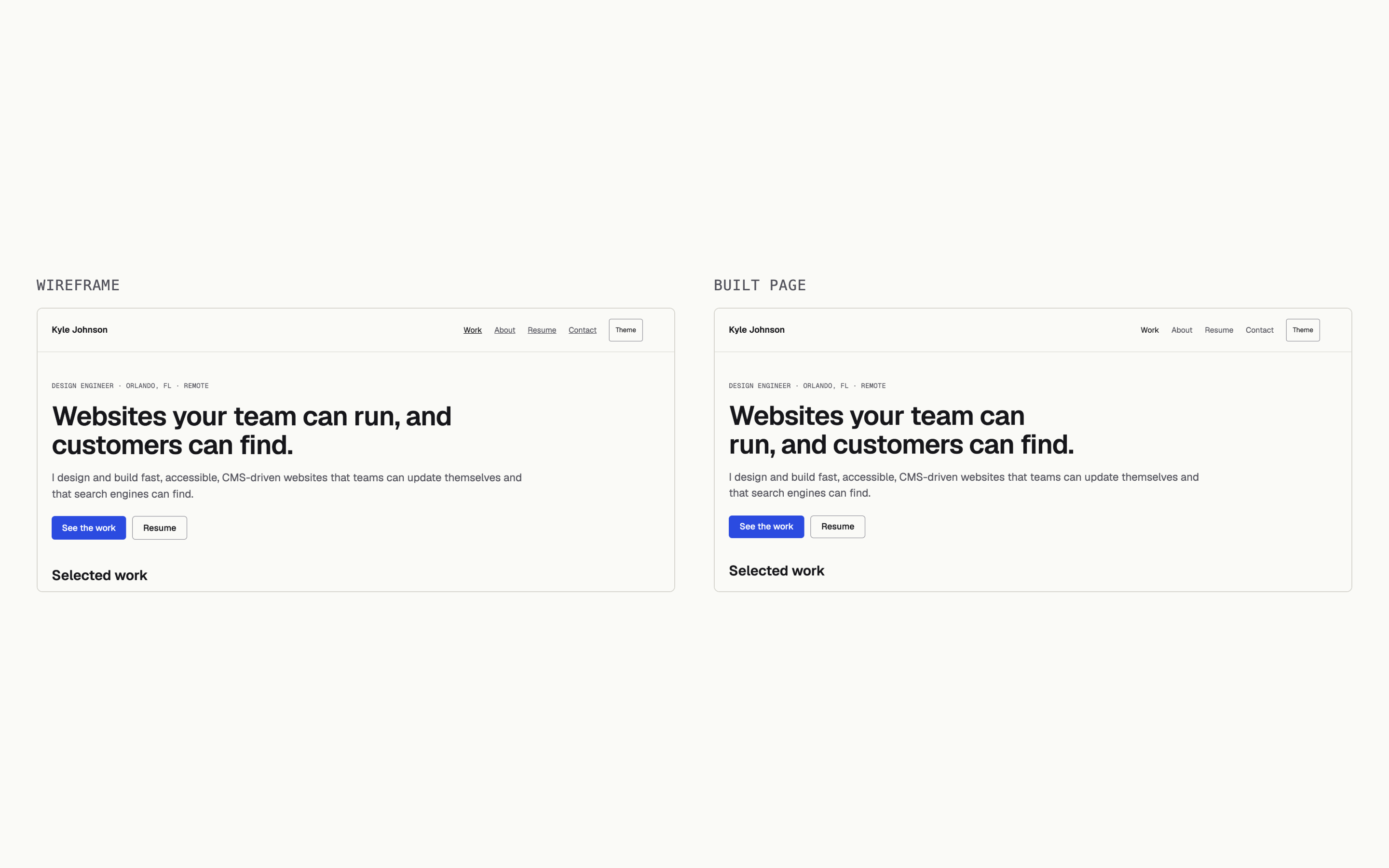
The site scores 100 in every Lighthouse category on mobile and has no axe violations in light or dark mode. Every page, case study and resume entry is edited in Sanity, not in code.
Every push runs Playwright with axe and Lighthouse on each page in the sitemap, so a new case study is tested the moment it's published, and a failing check blocks the merge.
I built it with Claude Code as a pair programmer. I wrote the rules it works under, the design system and the content model, and reviewed every step before it shipped.
The principles, tokens, components and accessibility rules are public: read the design system.
- 0 axe accessibility violations (WCAG 2.2 AA), light and dark mode, desktop and phone
- 83 → 100 home page Lighthouse mobile performance, after moving editing code off visitor pages
What's next
Publish the other case studies as their numbers come in, and move the site to its own domain.